Starting next year, Washington, DC will join Philadelphia as a major East Coast market without a PGA Tour stop, as the fall-out begins from the new 2007 tournament schedule.
In the case of the Booz Allen -- the tournament had been a fixture since it was the Kemper in 1980 -- the lead sponsor undertstandably was unwilling to cough up major millions for an event that was to become an after-thought in the fall.
For more, click here.
Friday, July 07, 2006


Thursday, July 06, 2006
Tiger on Phil flubbing the Open
Check out these juicy excerpts from Tiger Woods' pre-Western Open interview...
Q. Did you watch the end of the U.S. Open?
TIGER WOODS: You know, I watched both days. That was my punishment.
Q. Thoughts on Montgomerie and Mickelson?
TIGER WOODS: I thought in my opinion that it was Monty's tournament. In the fairway on 18 with -- not only in the fairway, he was on the right side, on the flat spot with a perfect angle with his fade. It doesn't get any better than that. With Phil on the tee, anything can still happen. He could still make bogey on the last hole and lose the tournament. I thought it was Monty's tournament, put the ball on the green and it's over. Obviously that didn't happen, and then Phil had his mistakes. It was a very interesting finish, one that none of us who are involved in the game of golf probably ever would have predicted we would have seen happening.
Q. Will Phil be able to brush off what happened to him at Winged Foot?
TIGER WOODS: I don't know. (Translation: I hope not)
More than likely to stay competitive you have to, especially in our sport. In our sport we fail more times than we succeed. Failure is a part of our sport; that's just the way it is. You pick yourself up off the ground and you have the next week to play. If we had a percentage very similar to baseball, if you put a .300 in your winning percentage, you'd have one hell of a career. But that's normally not the case. Your winning percentage is a lot lower than that, and you have to deal with losses quite a bit. It's nothing new to him, nothing new to any of us. You pick yourself up, dust yourself off, come back out the next week and play.
Q. What did you not playing on the weekend?
TIGER WOODS: I went spear fishing and came back and have been working on my game ever since.
Q. How frustrating was the U.S. Open?
TIGER WOODS: You know, it's something I don't normally do, missing the weekend at a major championship. Missing a weekend means that you have no opportunity to win the tournament. With the way I was playing, I felt if I could just get into the weekend and play two good rounds, I figured the guys would come back. I never even gave myself that opportunity to even fight for the championship.
Q. After Phil won The Masters there was a lot of talk about a rivalry between you and Phil. Your sense of the history and the Ernie and Jack legend, would you look forward to that rivalry blossoming?
TIGER WOODS: Well, all my career I've had rivals with Ernie, for a stretch with Vijay, with Duval, and I've had it with Phil. Just as long as I'm part of each conversation over the rest of my career (laughter), it's never a bad thing. (Translation: Don't mistake these pikers for No. 1 me).
Q. Were you ready to play the U.S. Open?
TIGER WOODS: I was rusty. I didn't execute properly, there's no doubt about that. There's no excuses for it. I had the same opportunities as everybody else to hit shots and I didn't do it.
It was very disappointing because I had good practice sessions, I felt I was prepared, and come game time I did not hit the proper shots. I didn't putt well on top of that, and it was just bad from tee to green.
Q. Can you speak about Sean O'Hair?
TIGER WOODS: Sean is good. I'll tell you, he's got just an enormous amount of talent, and on top of that, he is a nice guy. He really is fun to be around, and I think that he's got the proper mental attitude and approach to be successful, and not only be successful but be successful for a long period of time out here.
Q. Did you get a text message from Annika after she won on Monday?
TIGER WOODS: Yeah, she texted me (laughter). We're all square now. That's fine, we do that all the time to each other. It's fun having a friend who's competitive just like I am. She's one of the greatest that's ever played this sport. To see her go out there and how she prepares, it's pretty phenomenal to watch, not only from the golf standpoint but from the physicality standpoint of the effort level she puts into it. There's really no surprise why she's that successful if you watch how she prepares.
Q. Thoughts on Michelle Wie playing the John Deere Classic next week?
TIGER WOODS: I'll tell you what, she's playing great from what I've seen in the highlights, the way she's hitting it, it's been phenomenal. She's missed a couple of putts here and there, but overall she's hitting it great.
I think at the John Deere, that golf course is a little bit more wide open, where she can go ahead and let it go like she did last year and get it out there. There really is not that much trouble. I think she can go ahead and free-wheel it and let it go and hopefully she can make the cut.
Q. Has time helped since your father passed away?
TIGER WOODS: I'm sure it gets easier, but it's something you'll never, ever forget. I don't think it's ever something you ever really want to forget or ever really want to truly put behind you because having a parent that is so loving in your life and that you love so much, you never, ever forget that. Life lessons always come about, each and every day. I've talked to a bunch of my friends who have gone through it before, and they think about their lost parent every day. It happens.
That's something I've done and I will continue to do probably for the rest of my life.
Q. White Sox manager Ozzie Guillen said he would bet he could make a par on the PGA TOUR before you could get a hit in a major league game.
TIGER WOODS: I'd make a bet on that.
Q. Did you watch the end of the U.S. Open?
TIGER WOODS: You know, I watched both days. That was my punishment.
Q. Thoughts on Montgomerie and Mickelson?
TIGER WOODS: I thought in my opinion that it was Monty's tournament. In the fairway on 18 with -- not only in the fairway, he was on the right side, on the flat spot with a perfect angle with his fade. It doesn't get any better than that. With Phil on the tee, anything can still happen. He could still make bogey on the last hole and lose the tournament. I thought it was Monty's tournament, put the ball on the green and it's over. Obviously that didn't happen, and then Phil had his mistakes. It was a very interesting finish, one that none of us who are involved in the game of golf probably ever would have predicted we would have seen happening.
Q. Will Phil be able to brush off what happened to him at Winged Foot?
TIGER WOODS: I don't know. (Translation: I hope not)
More than likely to stay competitive you have to, especially in our sport. In our sport we fail more times than we succeed. Failure is a part of our sport; that's just the way it is. You pick yourself up off the ground and you have the next week to play. If we had a percentage very similar to baseball, if you put a .300 in your winning percentage, you'd have one hell of a career. But that's normally not the case. Your winning percentage is a lot lower than that, and you have to deal with losses quite a bit. It's nothing new to him, nothing new to any of us. You pick yourself up, dust yourself off, come back out the next week and play.
Q. What did you not playing on the weekend?
TIGER WOODS: I went spear fishing and came back and have been working on my game ever since.
Q. How frustrating was the U.S. Open?
TIGER WOODS: You know, it's something I don't normally do, missing the weekend at a major championship. Missing a weekend means that you have no opportunity to win the tournament. With the way I was playing, I felt if I could just get into the weekend and play two good rounds, I figured the guys would come back. I never even gave myself that opportunity to even fight for the championship.
Q. After Phil won The Masters there was a lot of talk about a rivalry between you and Phil. Your sense of the history and the Ernie and Jack legend, would you look forward to that rivalry blossoming?
TIGER WOODS: Well, all my career I've had rivals with Ernie, for a stretch with Vijay, with Duval, and I've had it with Phil. Just as long as I'm part of each conversation over the rest of my career (laughter), it's never a bad thing. (Translation: Don't mistake these pikers for No. 1 me).
Q. Were you ready to play the U.S. Open?
TIGER WOODS: I was rusty. I didn't execute properly, there's no doubt about that. There's no excuses for it. I had the same opportunities as everybody else to hit shots and I didn't do it.
It was very disappointing because I had good practice sessions, I felt I was prepared, and come game time I did not hit the proper shots. I didn't putt well on top of that, and it was just bad from tee to green.
Q. Can you speak about Sean O'Hair?
TIGER WOODS: Sean is good. I'll tell you, he's got just an enormous amount of talent, and on top of that, he is a nice guy. He really is fun to be around, and I think that he's got the proper mental attitude and approach to be successful, and not only be successful but be successful for a long period of time out here.
Q. Did you get a text message from Annika after she won on Monday?
TIGER WOODS: Yeah, she texted me (laughter). We're all square now. That's fine, we do that all the time to each other. It's fun having a friend who's competitive just like I am. She's one of the greatest that's ever played this sport. To see her go out there and how she prepares, it's pretty phenomenal to watch, not only from the golf standpoint but from the physicality standpoint of the effort level she puts into it. There's really no surprise why she's that successful if you watch how she prepares.
Q. Thoughts on Michelle Wie playing the John Deere Classic next week?
TIGER WOODS: I'll tell you what, she's playing great from what I've seen in the highlights, the way she's hitting it, it's been phenomenal. She's missed a couple of putts here and there, but overall she's hitting it great.
I think at the John Deere, that golf course is a little bit more wide open, where she can go ahead and let it go like she did last year and get it out there. There really is not that much trouble. I think she can go ahead and free-wheel it and let it go and hopefully she can make the cut.
Q. Has time helped since your father passed away?
TIGER WOODS: I'm sure it gets easier, but it's something you'll never, ever forget. I don't think it's ever something you ever really want to forget or ever really want to truly put behind you because having a parent that is so loving in your life and that you love so much, you never, ever forget that. Life lessons always come about, each and every day. I've talked to a bunch of my friends who have gone through it before, and they think about their lost parent every day. It happens.
That's something I've done and I will continue to do probably for the rest of my life.
Q. White Sox manager Ozzie Guillen said he would bet he could make a par on the PGA TOUR before you could get a hit in a major league game.
TIGER WOODS: I'd make a bet on that.
Wednesday, July 05, 2006
Mickelson's interview...
Here are exerpts from Phil Mickelson's pre-tournament interview at the Western Open.
PHIL MICKELSON: I'm looking forward to getting back and playing here. I haven't been to the Western Open in a few years. Already we're off to a fun night. We got here last night and there were fireworks all over the city that the kids saw. Another fun night tonight, we're going to take in a ballgame later this week, so it's been a fun week that we have scheduled for our family.
I have no idea what you might ask (laughter).
Q. Let's just get it out of the way. Nice to get back playing after a tough Open?
PHIL: It is. I think the biggest thing about that is that I don't want the one hole to affect my play in the next couple of majors, and so I've already been over to Hoylake, spent a few days there already doing most of the major prep work because if I can get that out of the way, I can focus more on getting my golf game ready for the tournament if I'm not doing all the preparation work.
I felt like I didn't execute the way I wanted to at the Open, and heading into the British, I want to make sure I have all the preparation work done, that I am able to focus on the shots that I need to hit and see if I can get execution to be sharp in the upcoming major.
Q. How long did it take for you to get it out of your system, and is it out of your system?
PHIL: Well, I'm not ever going to forget it, that's obvious. But what I'm not going to do is let it affect negatively my performance in upcoming majors. I've got two more this year. I'm playing too well, and I've got a system of preparation that has been helping me play some of my best golf, and right now I'm excited about the chances at Hoylake.
(Dave) Pelz and I have been mapping out our game plan over there. We've got the shots we want to hit. We're working on them this week. I've got Rick (Smith) here this week helping me to get those shots tight, and I'll be heading over right after this tournament to get ready for the British. I just don't want that one bad hole, again, to negatively affect the way I perform in the upcoming majors.
Q. Have you replayed, or at what point did you quit replaying that hole in your mind, and when you replayed it, if you did, would you have done anything different in retrospect?
PHIL: Well, I would have parred it (laughter).
Q. Club selection? You know what I mean.
PHIL: I know what you're saying. Fortunately what I have found has helped me play well or have that type of performances these past years in the majors is that I've done the prep work beforehand and I know what club selection I'm going to hit off each tee, given weather conditions, whether it's raining, whether it's hot or not. I already know and have known for weeks in advance what clubs I'm got to hit off each tee, so it's helped me approach the tee box with confidence knowing what club I'm going to hit.
It helped me when I hit the driver on 18 at Baltusrol on the last hole and ended up making a birdie. It helped me at The Masters knowing what club and what driver I was going to hit off each tee, and it helped me at the U.S. Open. Unfortunately I didn't execute the way I wanted to.
But it has erased a lot of the doubt as to the decision-making, what club am I going to hit, what club should I hit. I already know weeks in advance, and it helps me hit those shots and visualize those shots in practice before I ever show up the week of The Open.
Q. How about 18? Did you have an option there?
PHIL: Not for me, no. I couldn't get an iron or a wood past the turn of the dogleg. It set up perfect for a cut driver.
The difficulty that I had was I couldn't miss it left. I missed it left earlier in the week and fought to make bogey. Missed it left on Sunday and made double.
The second hole at the U.S. Open, I said, "Do not go right, stay left," because from left you have an angle up the green, you could run a shot up, get close, but from the right the trees cut you out. I missed it right four days in a row. My execution just wasn't what I wanted that week, and yet I fought and hung in there, and unfortunately I just needed to hang in there one more hole and wasn't able to do it.
Q. You beat yourself up pretty bad in the post-tournament comments after the Open. How long did you continue to beat yourself up over that?
PHIL: Well, again, that night it was decided that I'm not going to let one hole or one bad hole affect my upcoming tournaments. Sure, it's disappointing not to win the Open. I told you how much I wanted to win it. But I've got two more majors coming up, I'm playing too well to let one bad hole affect it, and I've got a pretty good game plan for the British.
Q. Not to harp on this, you said the decision was made that night not to let one hole affect the rest of your play. But what did you do? Once you left the course, once you got out from in front of all of us, did you go home, let the kids hug you? Did you fly back, put the clubs down for a couple days?
The trip home, the kids...
PHIL: We flew home Monday. I took my oldest daughter Amanda, who didn't have school - our other two did on Tuesday - to a club pool there, and we swam for six, seven hours that day. We went to Disneyland on Wednesday to celebrate her birthday. We had a great week, had a fun week. It could have been really fun (laughter), but it was just fun.
Q. How did you explain what happened at Winged Foot to your children? Is Amanda the only one old enough to really understand what happened?
PHIL: It basically went, "Did you win, Daddy?" "No." "I'm sorry. Do you want pizza?" Something like that.
Amy, am I close?
AMY MICKELSON: A little bit of "Second is so good, Daddy."
Q. When you won it at Augusta, it started a whole sort of fever about "Tiger and Phil." Do you let yourself daydream about what that would be like if the two of you were in the last group here or at a major?
PHIL: Not really. I mean, I would love to -- I love playing against him head-to-head. My record against him, again, is less than stellar. But I love having the chance to compete against the best players in the world, and he certainly is the best. There are a number of other guys, too, that are up there that I love playing against that are fun. Whether you win or lose, it makes for a fun day, a fun experience.
PHIL MICKELSON: I'm looking forward to getting back and playing here. I haven't been to the Western Open in a few years. Already we're off to a fun night. We got here last night and there were fireworks all over the city that the kids saw. Another fun night tonight, we're going to take in a ballgame later this week, so it's been a fun week that we have scheduled for our family.
I have no idea what you might ask (laughter).
Q. Let's just get it out of the way. Nice to get back playing after a tough Open?
PHIL: It is. I think the biggest thing about that is that I don't want the one hole to affect my play in the next couple of majors, and so I've already been over to Hoylake, spent a few days there already doing most of the major prep work because if I can get that out of the way, I can focus more on getting my golf game ready for the tournament if I'm not doing all the preparation work.
I felt like I didn't execute the way I wanted to at the Open, and heading into the British, I want to make sure I have all the preparation work done, that I am able to focus on the shots that I need to hit and see if I can get execution to be sharp in the upcoming major.
Q. How long did it take for you to get it out of your system, and is it out of your system?
PHIL: Well, I'm not ever going to forget it, that's obvious. But what I'm not going to do is let it affect negatively my performance in upcoming majors. I've got two more this year. I'm playing too well, and I've got a system of preparation that has been helping me play some of my best golf, and right now I'm excited about the chances at Hoylake.
(Dave) Pelz and I have been mapping out our game plan over there. We've got the shots we want to hit. We're working on them this week. I've got Rick (Smith) here this week helping me to get those shots tight, and I'll be heading over right after this tournament to get ready for the British. I just don't want that one bad hole, again, to negatively affect the way I perform in the upcoming majors.
Q. Have you replayed, or at what point did you quit replaying that hole in your mind, and when you replayed it, if you did, would you have done anything different in retrospect?
PHIL: Well, I would have parred it (laughter).
Q. Club selection? You know what I mean.
PHIL: I know what you're saying. Fortunately what I have found has helped me play well or have that type of performances these past years in the majors is that I've done the prep work beforehand and I know what club selection I'm going to hit off each tee, given weather conditions, whether it's raining, whether it's hot or not. I already know and have known for weeks in advance what clubs I'm got to hit off each tee, so it's helped me approach the tee box with confidence knowing what club I'm going to hit.
It helped me when I hit the driver on 18 at Baltusrol on the last hole and ended up making a birdie. It helped me at The Masters knowing what club and what driver I was going to hit off each tee, and it helped me at the U.S. Open. Unfortunately I didn't execute the way I wanted to.
But it has erased a lot of the doubt as to the decision-making, what club am I going to hit, what club should I hit. I already know weeks in advance, and it helps me hit those shots and visualize those shots in practice before I ever show up the week of The Open.
Q. How about 18? Did you have an option there?
PHIL: Not for me, no. I couldn't get an iron or a wood past the turn of the dogleg. It set up perfect for a cut driver.
The difficulty that I had was I couldn't miss it left. I missed it left earlier in the week and fought to make bogey. Missed it left on Sunday and made double.
The second hole at the U.S. Open, I said, "Do not go right, stay left," because from left you have an angle up the green, you could run a shot up, get close, but from the right the trees cut you out. I missed it right four days in a row. My execution just wasn't what I wanted that week, and yet I fought and hung in there, and unfortunately I just needed to hang in there one more hole and wasn't able to do it.
Q. You beat yourself up pretty bad in the post-tournament comments after the Open. How long did you continue to beat yourself up over that?
PHIL: Well, again, that night it was decided that I'm not going to let one hole or one bad hole affect my upcoming tournaments. Sure, it's disappointing not to win the Open. I told you how much I wanted to win it. But I've got two more majors coming up, I'm playing too well to let one bad hole affect it, and I've got a pretty good game plan for the British.
Q. Not to harp on this, you said the decision was made that night not to let one hole affect the rest of your play. But what did you do? Once you left the course, once you got out from in front of all of us, did you go home, let the kids hug you? Did you fly back, put the clubs down for a couple days?
The trip home, the kids...
PHIL: We flew home Monday. I took my oldest daughter Amanda, who didn't have school - our other two did on Tuesday - to a club pool there, and we swam for six, seven hours that day. We went to Disneyland on Wednesday to celebrate her birthday. We had a great week, had a fun week. It could have been really fun (laughter), but it was just fun.
Q. How did you explain what happened at Winged Foot to your children? Is Amanda the only one old enough to really understand what happened?
PHIL: It basically went, "Did you win, Daddy?" "No." "I'm sorry. Do you want pizza?" Something like that.
Amy, am I close?
AMY MICKELSON: A little bit of "Second is so good, Daddy."
Q. When you won it at Augusta, it started a whole sort of fever about "Tiger and Phil." Do you let yourself daydream about what that would be like if the two of you were in the last group here or at a major?
PHIL: Not really. I mean, I would love to -- I love playing against him head-to-head. My record against him, again, is less than stellar. But I love having the chance to compete against the best players in the world, and he certainly is the best. There are a number of other guys, too, that are up there that I love playing against that are fun. Whether you win or lose, it makes for a fun day, a fun experience.
Nix the USGA's 18-hole play-off format
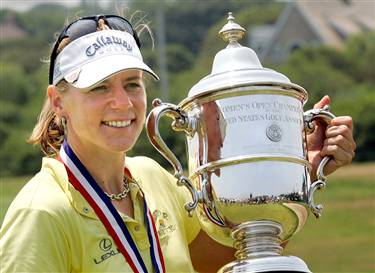
I'm with the AP's Doug Ferguson on the issue of the the USGA's 18-hole Monday play-off format being antiquated and punishing on the players, fans, tournament volunteers and everybody else.
For further proof, all you had to do was watch -- or endure -- Monday's dragged-out finish to the U.S. Women's Open, won by Annika Sorenstam.
For Fergy's Fringe column, click here.
No tears, no fears: Mickelson is back in action

Three weeks after he blew the U.S. Open, Phil Mickelson is back in action at this week's Western Open in Chicago. As Melanie Hauser notes in her story for pgatour.com, that Sunday night after the Open there were no tears, no fetal position for Mickelson. There was no time to wallow in self-pity, swapped as he was by his wife and three young kids.
For more on Lefty's chat with the media, click here.
And here's the AP's version of Mickelson's return.
Like fathers, like sons in Philly Boys' Junior


The final match of GAP's Philadelphia Boys' Junior Championship has come down to the sons from two prominent golf families: Matt Raudenbush of Pine Valley, son of Pine Valley head pro Charley Raudenbush and Michael Kania of Overbrook GC, son of top amateur Jim Kania.
For the details of the Junior and how Raudenbush and Kania reached the finals, click here to read the GAP coverage.
Friday, June 23, 2006

Thursday, June 22, 2006
Paddy backs Lefty

Padraig Harrington, who had his own troubles at the U.S. Open, finishing with a string to three straight bogeys to fall to 5th place, thinks Phil Mickelson was right to hit driver on the fateful 18th.
But Paddy doesn't feel all that much sympathy for Mickelson or Colin Montgomerie, another victim of a sad meltdown. Here's excerpts from Harrington's pre-tournament interview at this week's Booz Allen Classic.
Q. As badly as you feel, what you think Monty and Phil must be thinking at this point.
PADRAIG HARRINGTON: Well, the bunker is perfect. Not perfect, but it's not far off perfect. Once you hit it in the bunker or the first cut of rough on either side of the fairway, you can advance it up to the green. It was a pretty easy pin position on 18. You know, driver, get it down there, even if he misses the fairway, would mean he should get it around the green, on the green. I definitely think he played the right club for him. I don't think he carried the 3 wood. I would have hit 3 wood, but that would have been the right club for me. Looking back, I think he made the right choice in terms of his club selection offer the tee. I don't know what the second shot was like. He did win the last two majors before that. I wouldn't be judging him, let's say.
PADRAIG HARRINGTON: He probably got a little bit caught like me, that he wanted to make probably trying to make birdie down the last. When he missed the green, thinking that he needed to make at least four, running the putt by, you know, it's strange how often in a major you think you got to do things at the end. To be honest, sometimes you do. This is the problem. Nobody is a soothsayer or can tell what the winner's score is going to be. If Monty turned around at the last, he chipped it by 30 feet by the hole, he was a bit unlucky it didn't come back down, say he left it short and 2 putted, Phil finished four over, he would have been sick about it. You just can't tell what's going to happen. So many times, it does happen that guys like myself, Monty, Phil, make mistakes at the end. At other times, somebody does good things like Geoff Ogilvy chips in. You have to play every shot you think you need to play at the time. I'm sure Monty did that.
Paddy on the set-up at Winged Foot...
Q. Was last week the toughest setup that you faced in your career?
PADRAIG HARRINGTON: I actually thought last week was as straightforward a golf course as I've ever, ever played. That's one of the reasons why I feel so gutted. I think that's why so many of the Europeans did well. Like everything was in front of you. There wasn't a golf shot on that golf course that couldn't be hit, that couldn't be played. Maybe besides the pin on the back left of 18 and the pin on the front left of 18 were typical U.S. Open pins that I've seen in many years, you're looking at it saying, How am I going to get there? Certainly the front left pin in 18. You're playing I'm hitting my third shot in there Saturday. I'm trying to hit it to 60 feet away from the hole as my good shot. That's a tough mental thing to do, to try to hit a shot to 60 feet, and that's being your good shot. I pulled it toward the flag. I'm trying to hit a good shot that's going nowhere near it. That's usually what happens at the U.S. Open. This time everything was very straightforward, very fair. I've got to say, it was I say it was easy in terms of how the course played. Hit the fairway, hit the middle of the green. There was no shot there. I think, as well, with all the greens sloping back to front, I hit the ball low. There was no issue with me flying a ball in, trying to stop or hit it high. Most of the time there was plenty of room, you could hit it in and it would stop because of the slope of the green or you wanted to release up the green. Haven't come across a U.S. Open golf course that suited me as much as last week's course did.
Mickelson's misery

Days after blowing the Open, Phil Mickelson is still beating himself up. "It was how and when it happened," Mickelson's swing coach, Rick Smith, told Tommy Bonk of the LA Times.
For more on Mick's misery, click here.
My Round at Winged Foot

A day after Phil Mickelson and Colin Montgomerie gagged at the U.S. Open, I did a little gagging of my own at Winged Foot.
As it does most years, the USGA held a lottery for the media for a Monday morning round, and this year I was among the lucky. I played with Peter Kessler, formerly of the Golf Channel, now of XM Radio. It was 90 degrees and I was exhausted from the week of 12-14 hour days at the Open, which came on the heels of a long previous week at the McDonald's LPGA Championship.
This, of course, is my way of explaining just how badly I stunk, starting with the snowman on the the first hole. The new graduated rough at the Open was universially hailed, but let me tell you, when you got into the deep stuff, there was no gettin' out.
I hooked my opening tee shot into the grizzly green gnarl. Before I found it, I walked past my ball, over my ball and around the ball about three times. Even with a sand wedge, it was all I could do to hack it 30 feet not-so-forward -- into more of the deep stuff.
I do agree with Tiger Woods that the greens were a bit slow by Open standards. I'd guess they were running at about 10 on the Stimpmeter, which is slow. But I didn't think the greens were as bumpy as I expected after all the complaining by players.
Bottom line: It is an awesome course, easily one of my favorite Open venues.
Mulligan's Laws, Part 5
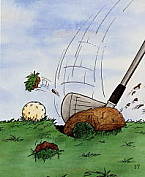
More truisms from the book Mulligan's Laws: A Lifetime of Golfing Wisdom from the Genius Who Invented the Do-Over:
It is surprisingly easy to hole a 50-foot putt when you lie 10.
Never leave your opponent with the sole responsibility for thinking of all the things that might go wrong with his shot.
The more often your opponent quotes the rules, the greater the certainty that he cheats.
Wednesday, June 21, 2006
Top 10

U.S. Open winner Geoff Ogilvy on Letterman

Top Ten Things That Went Through Geoff Ogilvy's Mind After Winning The U.S. Open
10. "This is one of those things you never forget like seeing John Daly in the locker room naked"9. "I wish I hand't put all my money on Phil Mickelson"
8. "Even I've never heard of me"
7. "Now I can take a vacation from the grind of playing golf all day"
6. "Crap - - I'm gonna have to go on Letterman"
5. "After all these years, I can finally use my 'World's Greatest Golfer' mug"
4. "I can quit my day job at Outback Steakhouse"
3. "What would Reteif Goosen do?"
2. "I hope this victory isn't overshadowed by America's world cup excitment"
1. "Thank you, Balco!"
Monday, June 19, 2006
Ogilvy post Open
 Most weeks out on the golf circuit, the players and the media don't stay in the same hotel. But we are this week at the U.S. Open.
In the halls and the lobby at the Crowne Plaza in White Plains this week, I have bumped into all manner of pros, from Jose Maria to Adam Scott. Not 10 minutes ago, I returned from grabbing a post-Open beer and burger in the lounge downstairs, where not 20 feet from me the new Open champion, Geoff Ogilvy, was celebrating with friends and well-wishers. Changed into jeans and a tee shirt, he and his wife were surrounded by about 30 fans, as they drank champagne from the Open cup. He posed for photos and signed anything anybody put in front of him.
Ogilvy is a quality player, and he will be heard from again. But in a way, I felt for him, because the 2006 U.S. Open will go down not as the one Ogilvy won but as the one Phil Mickelson blew.
Sunday, June 18, 2006
Mickelson at the Open: OUCH!
 Share Phil's pain. Read excerpts from his Open-ending interview:
Q. Talk about the disappointment that you must be feeling.
PHIL MICKELSON: Well, I still am in shock that I did that. I just can't believe that I did that. I am such an idiot. I just couldn't hit a fairway all day.
I tried to go to my bread and butter shot, a baby carve slice on 18 and just get it in the fairway, and I missed it left. I just can't believe I couldn't par the last hole. It really stings.
As a kid I dreamt of winning this tournament. I came out here and worked hard all four days, haven't made a bogey all week and then bogeyed the last hole. Even a bogey would have gotten me into a playoff. I just can't believe I did that.
Q. How is it different with this loss than the last two times when you finished second at the Open considering the success and the work you've made and the confidence and maturity in your game or have you had time to think about it?
PHIL MICKELSON: This one hurts more than any tournament because I had it won. I came out here a week or two ago in the evenings, just spending the evenings on the last four holes thinking that I would just need to make four pars, that there's a good chance if I can just make four pars on Sunday, I could do it. I made a good par on 15, bogeyed 16 and doubled 18.
So it hurts because I had it in my grasp and just let it go. As opposed to somebody making a long putt or what have you.
Q. What happened on the second shot? What was your lie like?
PHIL MICKELSON: I had a good lie. I had to hit a big carving slice around the tree and over cut it, just like I over cut the tee shot and some of the other shots. Obviously, in hindsight, if I hit it in the gallery and it doesn't cut, I am fine. I can still make bogey, even par. I ended up hitting the tree.
Q. You were trying to go around the tree, not over it?
PHIL MICKELSON: Around, yeah.
Q. When it didn't clear, what ran through your mind when you didn't do that?
PHIL MICKELSON: Again, I just couldn't believe it.
Q. Was there something that was right in your eye?
PHIL MICKELSON: I was far enough back where I could move it around and get it up on the green, or certainly by it. I had a nice lie and just over cut it, just cut too quick right in the tree.
Q. Were you playing for par on that second shot or bogey?
PHIL MICKELSON: Well, I was playing for a par. If I would make par, I'd win the tournament. I just thought, "I can slice this." I had 185 front, 201, I think, to the hole. I thought I'd just put the 3 iron on the green, or if not on it, around it, and get up and down.
Q. (Inaudible).
PHIL MICKELSON: No, I didn't have a 3 wood. I carried only a 4 wood. I felt like if I hit 4 wood and missed the fairway, I'd be too far back to do any good, to be able to chase one down there. I just tried to go to that little bread and butter carve slice, like I used at 13 at Augusta and some other holes, and over cut that, too.
PHIL MICKELSON: I didn't think that was an option. I had it cutting around the tree, but just too early.
Q. It was hard to stop, I imagine?
PHIL MICKELSON: It was buried. It plugged in the lip on 16, plugged in its divot on 18. I don't know what happened in those bunkers. I've never seen so much sand all week. Where those balls were, I just had very difficult shots.
Q. (Inaudible) what did you see there and what were you trying
PHIL MICKELSON: On 5? Well, I hit that shot better or can get it better out of the rough than a sand wedge, and I couldn't get a sand wedge back to the fairway it was sitting down so much. I kind of figured that might happen, but I didn't really have another shot at it.
Q. The second shot on 18, how close was that to being a perfect shot, maybe a foot or two?
PHIL MICKELSON: No, it wasn't that close. It over cut quite a bit. It had to go through it. Instead it hit a branch and went right back at me.
Q. How do you think you'll bounce back, Phil?
PHIL MICKELSON: Well, I'll head over to the British and try to get ready for that tournament. This one is going to take a little while to get over. This one is pretty disappointing.
Q. You mentioned that after a major gets over you spend three days in bed. Is that what's on the menu?
Mulligan's Laws, Part. 4
The less skilled the player, the more likely he is to share his ideas about the golf swing.
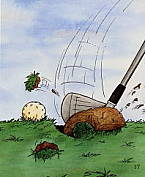
When your shot has to carry over a water hazard, you can either hit one more club or two more balls.
Golfers who claim they never cheat also lie.
Tiger's Open digs

Tiger Woods is gone from the U.S. Open, but not before bringing out gawkers who wanted to have a look at his yacht, Privacy, which he docked five minutes from the course.
One morning, when he emerged from below deck to head for the course, he was met by a photographer from the New York Post. Tiger had a few choice words for him.
For more, check out this story in the New York Times.
Ferrie Facts
If you don't know diddly about Kenneth Ferrie, the Englishman who shares the lead of the U.S. Open with Phil Mickelson, you're not alone. Not even the European golf writers know too much him.
Since Saturday night, I've spoken to three of my writer friends from London and Dublin and they all shake their heads. "I don't know where this is coming from," said one of them.
In his post-round interviews, Ferrie seems like a nice enough guy.
Here's Ferrie's player profile from the Open media guide:
KENNETH FERRIE
Birthdate: September 28, 1978
Birthplace: Ashington, England
Age: 27 Ht: 6'4" Wt: 245
Home: Ashington, England
Turned Professional: 1999
Joined European Tour: 2001
European Tour Playoff record: 1-0
European Tour Wins: 2, - 2003 Canarias Open De Espana, 2005 Smurfit European Open
Player Notes: Claimed his maiden European Tour title when he beat Peter Hedblom and Peter Lawrie at the second playoff hole at the 2003 Canarias Open de España. The 2002 winner had been Sergio Garcia which was appropriate for it was not the first time the pair's names had been placed side by side on a trophy, the first one being the British Boys Championship which Ferrie won in 1996 and Garcia won in 1997…Secured his card for the European Tour for the first time at the Qualifying School Finals in 2000. Won the Tessali Open del Sud on the Challenge Tour that year and finished joint runner-up the following week, but was unable to claim one of the precious 15 cards available through that route. Finished 193rd on the Volvo Order of Merit in 2001 but went to the Qualifying School Finals that year and took the 16th card. Narrowly avoided a return in 2002 when he finished 112th on the Volvo Order of Merit, his best finish being a share of third place in the Novotel Perrier Open de France. Coached by John Harrison. Brother, Iain, has also played on the Challenge Tour.
Claimed the biggest title of his career in July 2005 when he stood firm as others faltered at The K Club in Ireland to win the Smurfit European Open. Nearly followed that up with another victory in the Dunhill Links Championship in October but was overhauled by Colin Montgomerie in a thrilling last-round duel on the Old Course at St Andrews. Biggest disappointment of the year was narrowly losing out to Nick Dougherty for the final automatic place in the Great Britain and Ireland team for the Seve Trophy in his native northeast of England but took considerable consolation from the fact that he finished the year 11th on the Order of Merit, by far his best season on Tour.
2001 PGA European Tour Summary: Tournaments entered - 20; in money - 7; top-10 finishes - 0; stroke average 73.44 (ranked 197th); money _30,330 & £18,585 (ranked 193rd); best finish, T12th, North West of Ireland Open.
2002 PGA European Tour Summary: Tournaments entered - 20; in money - 7; top-10 finishes - 3; stroke average 72.71 (ranked 149th); money _182,625 & £116,444 (ranked 112th); best finish, T3rd, Novotel Perrier Open de France.
2003 PGA European Tour Summary: Tournaments entered - 30; in money - 16; top-10 finishes - 3; stroke average 71.87 (ranked 103rd); money _628,539 & £438,223 (ranked 34th); winner Canarias Open de Espana.
2004 PGA European Tour Summary: Tournaments entered - 26; in money - 16; top-10 finishes - 2; stroke average 72.01 (ranked 103rd); money _281,200 & £194,457 (ranked 72nd); best finish 9th, Linde German Masters.
2005 PGA European Tour Summary: Tournaments entered - 28; in money - 19; top-10 finishes - 5; stroke average 71.93 (ranked 108th); money _1,410,636 & £953,448 (ranked 11th); Winner, Sumrfit European Open.
Since Saturday night, I've spoken to three of my writer friends from London and Dublin and they all shake their heads. "I don't know where this is coming from," said one of them.
In his post-round interviews, Ferrie seems like a nice enough guy.
Here's Ferrie's player profile from the Open media guide:
KENNETH FERRIE
Birthdate: September 28, 1978
Birthplace: Ashington, England
Age: 27 Ht: 6'4" Wt: 245
Home: Ashington, England
Turned Professional: 1999
Joined European Tour: 2001
European Tour Playoff record: 1-0
European Tour Wins: 2, - 2003 Canarias Open De Espana, 2005 Smurfit European Open
Player Notes: Claimed his maiden European Tour title when he beat Peter Hedblom and Peter Lawrie at the second playoff hole at the 2003 Canarias Open de España. The 2002 winner had been Sergio Garcia which was appropriate for it was not the first time the pair's names had been placed side by side on a trophy, the first one being the British Boys Championship which Ferrie won in 1996 and Garcia won in 1997…Secured his card for the European Tour for the first time at the Qualifying School Finals in 2000. Won the Tessali Open del Sud on the Challenge Tour that year and finished joint runner-up the following week, but was unable to claim one of the precious 15 cards available through that route. Finished 193rd on the Volvo Order of Merit in 2001 but went to the Qualifying School Finals that year and took the 16th card. Narrowly avoided a return in 2002 when he finished 112th on the Volvo Order of Merit, his best finish being a share of third place in the Novotel Perrier Open de France. Coached by John Harrison. Brother, Iain, has also played on the Challenge Tour.
Claimed the biggest title of his career in July 2005 when he stood firm as others faltered at The K Club in Ireland to win the Smurfit European Open. Nearly followed that up with another victory in the Dunhill Links Championship in October but was overhauled by Colin Montgomerie in a thrilling last-round duel on the Old Course at St Andrews. Biggest disappointment of the year was narrowly losing out to Nick Dougherty for the final automatic place in the Great Britain and Ireland team for the Seve Trophy in his native northeast of England but took considerable consolation from the fact that he finished the year 11th on the Order of Merit, by far his best season on Tour.
2001 PGA European Tour Summary: Tournaments entered - 20; in money - 7; top-10 finishes - 0; stroke average 73.44 (ranked 197th); money _30,330 & £18,585 (ranked 193rd); best finish, T12th, North West of Ireland Open.
2002 PGA European Tour Summary: Tournaments entered - 20; in money - 7; top-10 finishes - 3; stroke average 72.71 (ranked 149th); money _182,625 & £116,444 (ranked 112th); best finish, T3rd, Novotel Perrier Open de France.
2003 PGA European Tour Summary: Tournaments entered - 30; in money - 16; top-10 finishes - 3; stroke average 71.87 (ranked 103rd); money _628,539 & £438,223 (ranked 34th); winner Canarias Open de Espana.
2004 PGA European Tour Summary: Tournaments entered - 26; in money - 16; top-10 finishes - 2; stroke average 72.01 (ranked 103rd); money _281,200 & £194,457 (ranked 72nd); best finish 9th, Linde German Masters.
2005 PGA European Tour Summary: Tournaments entered - 28; in money - 19; top-10 finishes - 5; stroke average 71.93 (ranked 108th); money _1,410,636 & £953,448 (ranked 11th); Winner, Sumrfit European Open.
Saturday, June 17, 2006
Mulligan's Laws, Part. 3
 More pearls of wisdom from Mulligan's Laws: A Lifetime of Golfing Wisdom from the Genius Who Invented the Do-Over.
Don't play with anyone who would question a 7.
No matter how badly you are playing, it is always possible to play worse.
Never try to keep more than 300 separate thoughts in your mind during your swing.
David Duval at the podium
Q. You had fun with the crowd, didn't you, today?
DAVID DUVAL: They really seemed behind me. You know, I've always enjoyed playing up in this area. I've only missed the Westchester event when I've had to miss it. You know, I think they get to see me a lot, and they know I'm coming back and playing well, and they're pulling for me.
Q. (Inaudible).
DAVID DUVAL: I know, I've never led anybody to believe otherwise. If it's not my favorite, it's tied for my favorite event of the year with the Open Championship. I think especially in the last couple years, the golf courses have been set up just how they should be and have been fair and just, extremely hard.
Q. There was a nine stroke discrepancy between yesterday and today. What was working for you today and didn't work yesterday?
DAVID DUVAL: You know, I made some putts and hit the ball just a little bit better.
Here he gets testy, the Duval of old...
Q. The state of your game, even though the scores aren't always there, have you been feeling the last few months or several months
DAVID DUVAL: I guess you haven't been listening. I've been saying that for I don't know how long and nobody wants to seem to listen. I'm playing well. I'll say it again, I'm playing very well. I made some putts today a couple times when I needed to to keep my round going. I did it, and the little things added up a little bit better today than they have the past six months of this year so far.
Q. You're pretty confident over the ball, and after you stroked it on the par putts on 4, 5 and 9, are you feeling a lot better on the greens?
DAVID DUVAL: Yeah, I felt better today than yesterday. I struggled getting comfortable yesterday. Today I felt a lot more comfortable over the ball. I felt like I was aiming the ball a lot better than I did yesterday.
Q. Talk about the 6th hole.
DAVID DUVAL: My third shot?
Q. Yeah.
DAVID DUVAL: I didn't have an out. I felt like I had to play right of the hole and try to get it on the green over there. If I'm aiming at the flag area or even left and it grabs the hosel, go right over the green in the hazard and I'd really have a problem. The mistake there wasn't any of the shots I played, any of the six shots I played. Well, I guess it was the first shot was the mistake I made, and it wasn't so much because it was a bad shot; you have those. It was not even close to the right club. I'm hitting the ball on a string and there's no reason I shouldn't hit it right on the front of the green or in the left bunker or something. It's only 300 yards, 310 yards to the front. Anywhere up around there I can get it on the green.
...more testiness...
Q. Just your thoughts on making the cut in a major and being here on the weekend.
DAVID DUVAL: I guess that's the difference between you and me; I don't think that way. I'm not thinking along those lines of whether I've done it recently or not. It's a matter of confidence and how I'm playing and my results haven't been nearly what I thought they should be this year up to this point, and I just look forward to a really good second half of the year.
Q. Is your confidence growing month by month or week by week or even day by day?
DAVID DUVAL: All those. I felt like I played pretty well at Augusta overall. I had a big test ahead of me for the last 16 holes of that tournament, I guess holes 20 through 36 for me. I guess that's where some of the hardships of how I've played the last few years, that's where the importance of little things like that come into play. I know I'm playing well and I certainly am not going to pack it in, but at that point I've got no chance of making the cut.
But I'm not going to quit. I'm going to keep playing and building on it.
Q. How does it feel to be in contention again?
DAVID DUVAL: Well, you know what, it feels wonderful. Simple things like last week, I'm scratching my head. I felt like after two days I should be in contention and I don't even get to play on the weekend. I hit the ball well enough to be doing that, but the little things, unless you're out following and seeing an entire round of golf. You see the scores when you get done and you don't know what happened. It's those little things that need to add up in a round of golf that haven't for me.
Like I said, I felt great last week, hit the ball well. I could have hit a few more greens, but I really struggled with those real soft poa annua greens with the amount I spin the ball. It was hard to get to the flags. I felt great coming here. I was prepared and ready to play.
DAVID DUVAL: They really seemed behind me. You know, I've always enjoyed playing up in this area. I've only missed the Westchester event when I've had to miss it. You know, I think they get to see me a lot, and they know I'm coming back and playing well, and they're pulling for me.
Q. (Inaudible).
DAVID DUVAL: I know, I've never led anybody to believe otherwise. If it's not my favorite, it's tied for my favorite event of the year with the Open Championship. I think especially in the last couple years, the golf courses have been set up just how they should be and have been fair and just, extremely hard.
Q. There was a nine stroke discrepancy between yesterday and today. What was working for you today and didn't work yesterday?
DAVID DUVAL: You know, I made some putts and hit the ball just a little bit better.
Here he gets testy, the Duval of old...
Q. The state of your game, even though the scores aren't always there, have you been feeling the last few months or several months
DAVID DUVAL: I guess you haven't been listening. I've been saying that for I don't know how long and nobody wants to seem to listen. I'm playing well. I'll say it again, I'm playing very well. I made some putts today a couple times when I needed to to keep my round going. I did it, and the little things added up a little bit better today than they have the past six months of this year so far.
Q. You're pretty confident over the ball, and after you stroked it on the par putts on 4, 5 and 9, are you feeling a lot better on the greens?
DAVID DUVAL: Yeah, I felt better today than yesterday. I struggled getting comfortable yesterday. Today I felt a lot more comfortable over the ball. I felt like I was aiming the ball a lot better than I did yesterday.
Q. Talk about the 6th hole.
DAVID DUVAL: My third shot?
Q. Yeah.
DAVID DUVAL: I didn't have an out. I felt like I had to play right of the hole and try to get it on the green over there. If I'm aiming at the flag area or even left and it grabs the hosel, go right over the green in the hazard and I'd really have a problem. The mistake there wasn't any of the shots I played, any of the six shots I played. Well, I guess it was the first shot was the mistake I made, and it wasn't so much because it was a bad shot; you have those. It was not even close to the right club. I'm hitting the ball on a string and there's no reason I shouldn't hit it right on the front of the green or in the left bunker or something. It's only 300 yards, 310 yards to the front. Anywhere up around there I can get it on the green.
...more testiness...
Q. Just your thoughts on making the cut in a major and being here on the weekend.
DAVID DUVAL: I guess that's the difference between you and me; I don't think that way. I'm not thinking along those lines of whether I've done it recently or not. It's a matter of confidence and how I'm playing and my results haven't been nearly what I thought they should be this year up to this point, and I just look forward to a really good second half of the year.
Q. Is your confidence growing month by month or week by week or even day by day?
DAVID DUVAL: All those. I felt like I played pretty well at Augusta overall. I had a big test ahead of me for the last 16 holes of that tournament, I guess holes 20 through 36 for me. I guess that's where some of the hardships of how I've played the last few years, that's where the importance of little things like that come into play. I know I'm playing well and I certainly am not going to pack it in, but at that point I've got no chance of making the cut.
But I'm not going to quit. I'm going to keep playing and building on it.
Q. How does it feel to be in contention again?
DAVID DUVAL: Well, you know what, it feels wonderful. Simple things like last week, I'm scratching my head. I felt like after two days I should be in contention and I don't even get to play on the weekend. I hit the ball well enough to be doing that, but the little things, unless you're out following and seeing an entire round of golf. You see the scores when you get done and you don't know what happened. It's those little things that need to add up in a round of golf that haven't for me.
Like I said, I felt great last week, hit the ball well. I could have hit a few more greens, but I really struggled with those real soft poa annua greens with the amount I spin the ball. It was hard to get to the flags. I felt great coming here. I was prepared and ready to play.
Tiger at the Open: The exit interview
Q. Tiger, just trouble again with the greens?
TIGER WOODS: I didn't execute properly today. I didn't drive the ball all that great, didn't hit my irons well and didn't have the speed again, so not a good combo.
Q. Tell us what your emotional state is right now.
TIGER WOODS: Pissed. That pretty much sums it up right there. I thought I was playing well enough to shoot an under par round today, and I didn't do that.
Q. Was it rust?
TIGER WOODS: No, not rust. Unfortunately I just didn't put it together at the right time. I just didn't execute properly, and consequently, I shot 6 over.
Q. Was there a moment today where (inaudible).
TIGER WOODS: No.
Q. You thought as you kept grinding, you still thought you were going to turn it around?
TIGER WOODS: You've always got to feel that way. I felt like if I just kept going, kept plodding along, I could have turned it around any time with one putt or one shot. And I made two good saves there on 18 and 1 and thought that that would be pretty good. Then made a good par there on 3. All in all, I thought I could have turned it around there.
Q. This is kind of a tough tournament and a tough venue to come back. Talk about that.
TIGER WOODS: It is. It's playing really hard. The golf course is very difficult. The wind is up now, just like it was yesterday afternoon. Marginal shots are just going to get killed here; it's just the nature of this golf course. Any U.S. Open, but more so on this golf course, but any U.S. Open venue that we play, any marginal shot here just gets penalized more so than any other Open.
Q. You've never missed a cut in a major. Can you talk about that?
TIGER WOODS: It's not something you want to have happen. I've gone, I guess, a while without missing one. Unfortunately I missed this one, and hopefully I can win the British.
Q. (Inaudible).
TIGER WOODS: Yeah, I knew if I made one birdie coming in and a couple pars, the ten shot rule would get me in.
Q. 20/20 hindsight, would you have (inaudible).
TIGER WOODS: No, I was not ready to play golf.
Q. What's next?
TIGER WOODS: Practice.
Q. Will you play before the British?
TIGER WOODS: Probably the Western.
Q. You said coming into this you felt really good about where your game was. How shocking is this to you?
TIGER WOODS: More frustrating than anything else because I was hitting the ball really well. I struggled all week with getting the speed of these things because they were slower the mindset of a U.S. Open is really slick greens, and these aren't. I struggled all week trying to hit the putts hard enough, and then yesterday it bit me right at the start.
Once I adjusted, as I said yesterday, it was too late. Then today they were nice; they were a little bit faster but still on the slow side. Uphill putts are really slow, and downhill putts just don't quite run out. You have to make the adjustment, and I didn't do that.
Q. Considering what you've had to deal with off the golf course, did it help you to maybe deal with disappointment in tournament play in a major when things don't work out? Is there any way that you've changed or matured with respect to your game and your results?
TIGER WOODS: When you don't execute, you're not going to be happy either way. What's transpired off the golf course, I don't know if it gives you a different type of perspective. But I don't care if you had what transpired in my life of recent or not, but poor execution is never going to feel very good.
TIGER WOODS: I didn't execute properly today. I didn't drive the ball all that great, didn't hit my irons well and didn't have the speed again, so not a good combo.
Q. Tell us what your emotional state is right now.
TIGER WOODS: Pissed. That pretty much sums it up right there. I thought I was playing well enough to shoot an under par round today, and I didn't do that.
Q. Was it rust?
TIGER WOODS: No, not rust. Unfortunately I just didn't put it together at the right time. I just didn't execute properly, and consequently, I shot 6 over.
Q. Was there a moment today where (inaudible).
TIGER WOODS: No.
Q. You thought as you kept grinding, you still thought you were going to turn it around?
TIGER WOODS: You've always got to feel that way. I felt like if I just kept going, kept plodding along, I could have turned it around any time with one putt or one shot. And I made two good saves there on 18 and 1 and thought that that would be pretty good. Then made a good par there on 3. All in all, I thought I could have turned it around there.
Q. This is kind of a tough tournament and a tough venue to come back. Talk about that.
TIGER WOODS: It is. It's playing really hard. The golf course is very difficult. The wind is up now, just like it was yesterday afternoon. Marginal shots are just going to get killed here; it's just the nature of this golf course. Any U.S. Open, but more so on this golf course, but any U.S. Open venue that we play, any marginal shot here just gets penalized more so than any other Open.
Q. You've never missed a cut in a major. Can you talk about that?
TIGER WOODS: It's not something you want to have happen. I've gone, I guess, a while without missing one. Unfortunately I missed this one, and hopefully I can win the British.
Q. (Inaudible).
TIGER WOODS: Yeah, I knew if I made one birdie coming in and a couple pars, the ten shot rule would get me in.
Q. 20/20 hindsight, would you have (inaudible).
TIGER WOODS: No, I was not ready to play golf.
Q. What's next?
TIGER WOODS: Practice.
Q. Will you play before the British?
TIGER WOODS: Probably the Western.
Q. You said coming into this you felt really good about where your game was. How shocking is this to you?
TIGER WOODS: More frustrating than anything else because I was hitting the ball really well. I struggled all week with getting the speed of these things because they were slower the mindset of a U.S. Open is really slick greens, and these aren't. I struggled all week trying to hit the putts hard enough, and then yesterday it bit me right at the start.
Once I adjusted, as I said yesterday, it was too late. Then today they were nice; they were a little bit faster but still on the slow side. Uphill putts are really slow, and downhill putts just don't quite run out. You have to make the adjustment, and I didn't do that.
Q. Considering what you've had to deal with off the golf course, did it help you to maybe deal with disappointment in tournament play in a major when things don't work out? Is there any way that you've changed or matured with respect to your game and your results?
TIGER WOODS: When you don't execute, you're not going to be happy either way. What's transpired off the golf course, I don't know if it gives you a different type of perspective. But I don't care if you had what transpired in my life of recent or not, but poor execution is never going to feel very good.
Subscribe to:
Posts (Atom)